


Humero-Ulnar Joint Mobilizations

Passive Flexion Mobilization
Patient: lying decubitus supine (facing up) with his/her arm lying supinated on the bench.
PT (Physical Therapist): standing homolateral to the pacient.
Fixating hand: the PT hand fixates the humerus to the bench.
Mobilizing Hand: the free hand grabs the patient´s distal forearm.
Movement: flexion of the elbow.
Objective: maintain elbow flexion.

Passive Extension Mobilization
Patient: lying decubitus supine (facing up) with his/her arm lying supinated on the bench.
PT (Physical Therapist): standing homolateral to the pacient.
Fixating hand: the PT hand fixates the humerus to the bench.
Mobilizing Hand: the free hand grabs the patient´s distal forearm.
Movement: extension of the elbow.
Objective: maintain elbow extension.

Varus Mobilization
Patient: lying decubitus supine (facing up) with his/her arm in 10º-20º of flexion.
PT (Physical Therapist): standing homolateral to the pacient.
Fixating hand: the PT hand fixates the radius from its side.
Mobilizing Hand: the free hand grabs the medial epicondile of the humerus.
Movement: push the humerus in a radial direction.
Objective: increase varus of the arm.
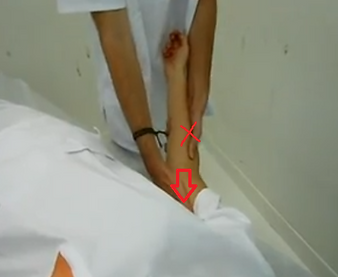
Valgus Mobilization
Patient: lying decubitus supine (facing up) with his/her arm in 10º-20º of flexion.
PT (Physical Therapist): standing homolateral to the pacient.
Fixating hand: the PT hand fixates the ulna by its medial side (above medial epicondyle).
Mobilizing Hand: the free hand grabs the lateral epicondile of the humerus.
Movement: push the humerus in a ulnar direction.
Objective: increase valgus of the arm.

Traction Grade I, II, and III
Patient: lying decubitus lateral (sideways) on the affected side. The posterior part of the arm lies on the bench with its olecranon outside the bench. Elbow on its resting position.
PT (Physical Therapist): standing in front of the pacient.
Fixating hand: the PT hand fixates the distal end of the humerus against the bench while palpating the joint line with the ulna.
Mobilizing Hand: the free hand grabs the proximal end of the forearm from the anterior part.
Movement: do a traction perpedicular to the humerus.
Objective: to treat hipomobility, pain, and limitations on the flexion and extension of the elbow.

Radial Gliding of the Ulna
Patient: lying decubitus lateral on the affected side. The lateral side of the humerus lies on a wedge, close to the joint line.
PT (Physical Therapist): standing in front of the pacient´s affected arm.
Fixating hand + Mobilizing Hand: both hands grab the ulnar side of the forearm by its proximal and distal side.
Movement: push the ulnar part of the forear in a radial direction. The PT uses his/her bodyweight to apply the force (flexing the knees).
Objective: to increase varus and treat flexion and extension hypomobility.

Ulnar Gliding of the Ulna
Patient: lying decubitus lateral on the affected side. The arm is flexed and lying on its radial side on the wedge, cloe to the joint line.
PT (Physical Therapist): standing in front of the pacient´s affected arm.
Fixating hand: the hand fixates the ulnar side of the forearm to the wedge.
Mobilizing Hand: this hand grabs the humerus by its medial-proximal part.
Movement: push the proximal part of the humerus in a ulnar direction. The PT uses his/her bodyweight to apply the force (flexing the knees).
Objective: to increase valgus and treat flexion and extension hypomobility.
The humero-ulnar articulation is a trochlear artiulation. It can do the movements of flexion and extension. It follows the concave rule.
Resting Position: 70º of elbow flexion, 10º supination.
Blocking Position: elbow extended, forearm supinated.
Zero Position: frontal plane, elbow extended, forearm supinated.
Capsular Pattern: proportion of flexion-extension limitated: 90º-10º
